MSF Response to the War in Lebanon
Lebanon: After more than 100 days of crisis, civilians need protection, healthcare, and urgent support
Latest Update: 23 June 2026
As discussions around a regional deal that includes Lebanon move forward, the situation on the ground remains deeply uncertain, and it is still unclear whether this latest ceasefire will bring meaningful improvements for the people in the country. For communities across Lebanon, the road to this moment has been marked by more than 100 days of uninterrupted and devastating humanitarian crisis that will have long-lasting impact.
For many, the announcement of a ceasefire does not yet mean safety. The previous ceasefire, announced on 17 April after 46 days of conflict, failed to protect civilians or the healthcare system. Attacks continued, forced displacement orders remained in place, and the Israeli ground invasion kept advancing. Today, people are waiting to see whether this ceasefire will bring real protection.
The human toll over this period has been devastating. Between 2 March and 22 June 2026, more than 4,100 people were killed and more than 12,000 injured.
Even with the announcement of a new ceasefire, the situation remains deeply unstable. Today, parts of the country remain under occupation. Around one million civilians have been displaced from their homes, some for more than 100 days, while others have endured multiple displacement since 2023, with no clear end in sight for families uprooted from occupied areas.
As some people begin to return while others remain displaced, MSF is adapting its activities across the country. For many families, the risk of returning remains high, especially in areas where insecurity persists and access to healthcare, drinking water, and essential services is still limited.
MSF’s response
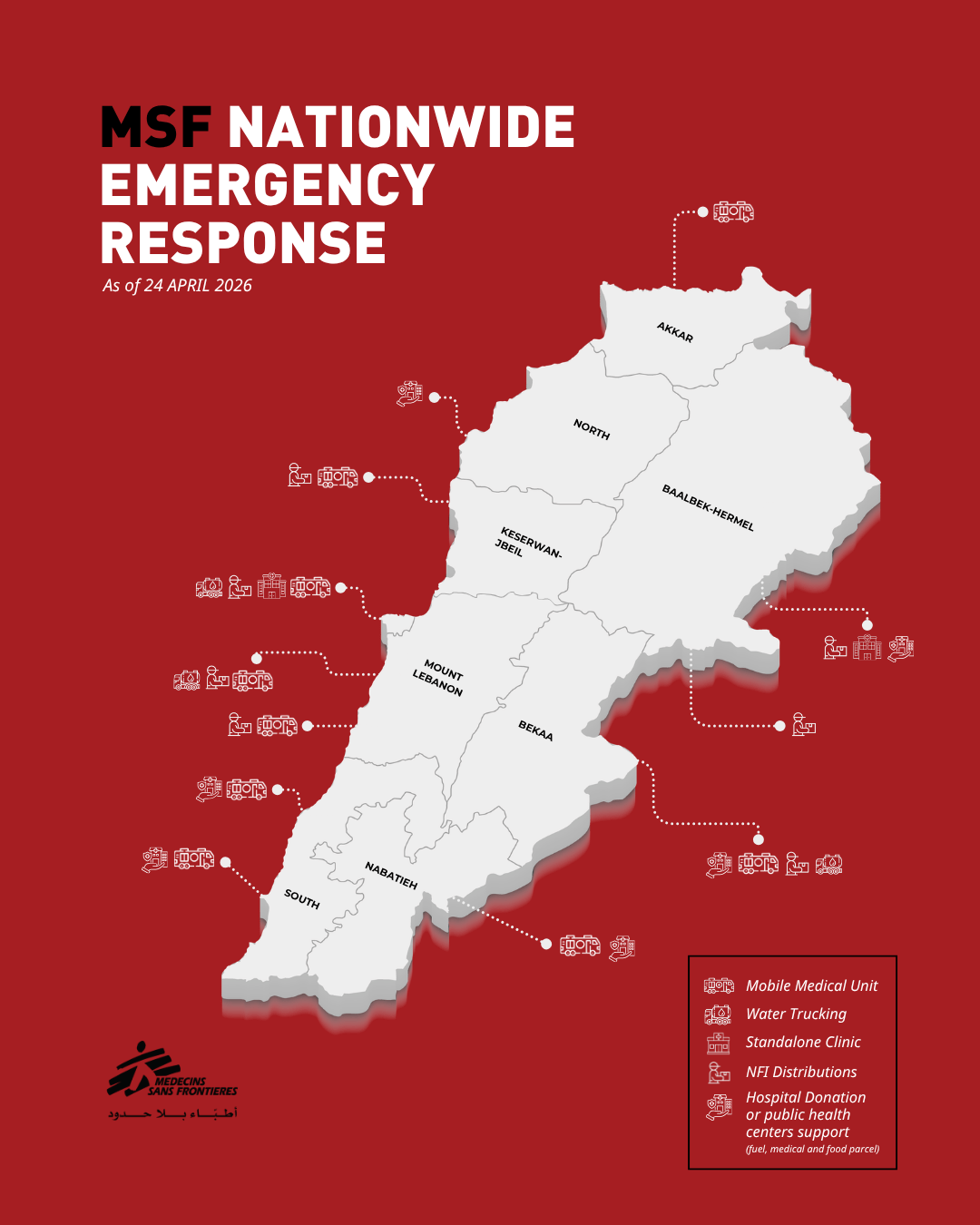
MSF continues to run a nationwide emergency response in Lebanon, providing essential medical services, supporting hospitals, primary healthcare centres, rescue teams and ambulance services, and delivering water, sanitation, and hygiene assistance to people affected by the crisis.
Since the start of the escalation, MSF has rapidly scaled up its emergency response across the country, adapting activities as needs and access constraints evolved. Across the country, our teams are running mobile clinics that provide primary healthcare, mental health support, sexual and reproductive healthcare, and referrals to hospitals when needed.
In parallel, MSF expanded support to hospitals and primary healthcare centres through medical donations, fuel support, direct trauma interventions, and emergency care. We also run a stand-alone clinic in Burj Hammoud, in Beirut’s suburbs, and another one in Hermel, in the Bekaa Valley.
To support access to healthcare we also launched a mental health helpline and a localised telemedicine service for people who may otherwise face difficulties accessing care, whether due to insecurity, displacement, or other barriers. Through this service, patients receive medication via an ambulatory system, while MSF doctors provide follow-up consultations by phone.
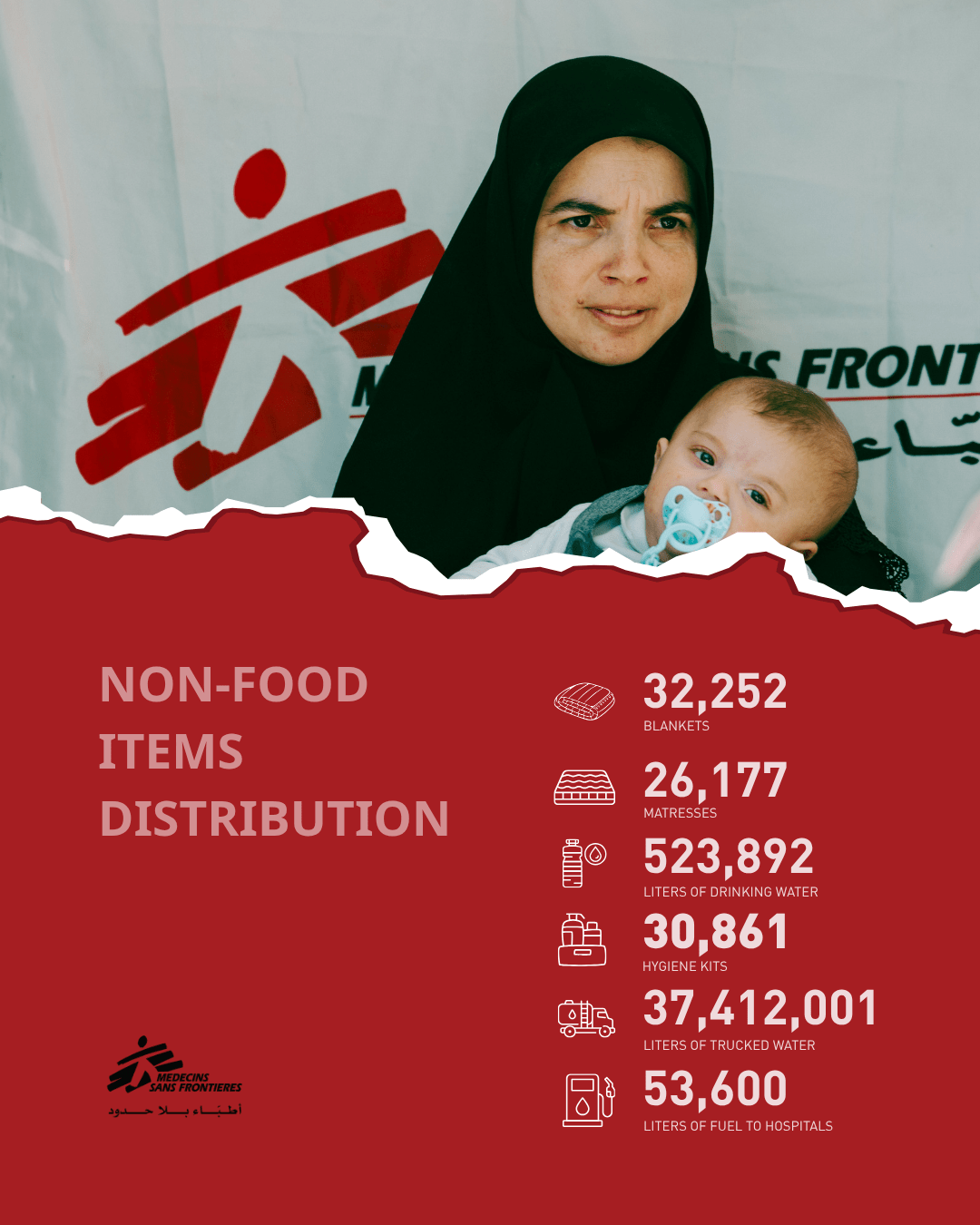
MSF’s response also includes relief and WASH activities. In the first days of the escalation, our teams began distributing essential relief items, including blankets, mattresses, hygiene kits, and drinking water, to people affected by the violence and to families sheltering in collective sites.
MSF continuously adapts its activities based on the evolving needs of the people and the context on the ground. If security tensions persist, we will continue to assess the situation carefully and adjust our operations accordingly to ensure that assistance reaches those who need it most.
MSF activities in numbers
Between 2 March and , MSF is supporting the response through:
- Mobile clinics serving 13 districts: Nabatiyeh, Chouf, Rashaiya, West Bekaa, Baalbek, Zahle, Hermel, Central Beirut, Sour/Tyre, Tripoli, Dahiyeh, Saida, and Aley
- Support to 16 hospitals, including Jabal Amel hospital in Sour/Tyre, Najdeh Al-Shaabiyeh hospital in Nabatiyeh, and Mashghara Hospital in the Bekaa Valley
- Support to 21 primary healthcare centres across the country
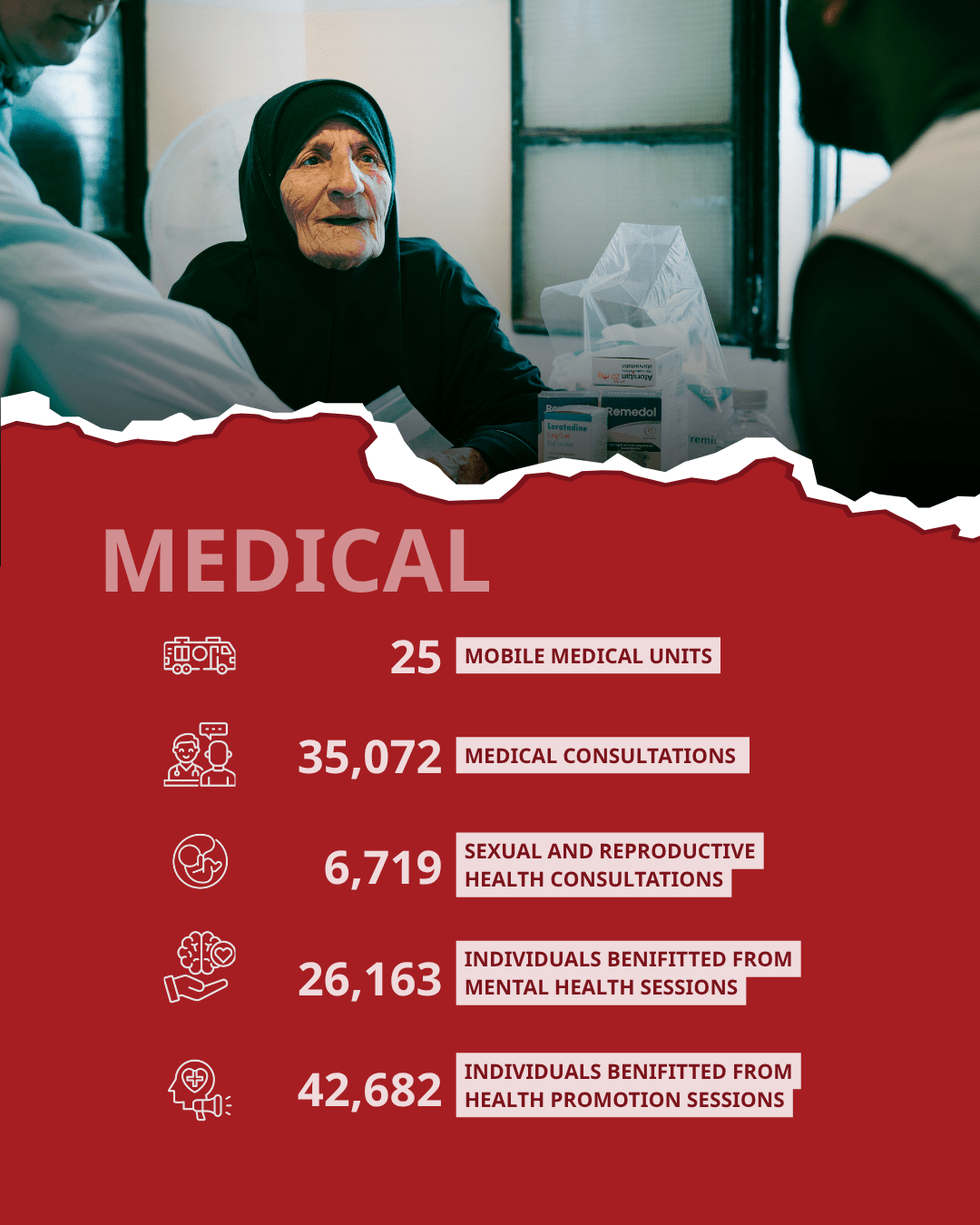
Medical activities through mobile clinics
- 90,930 people reached through health promotion sessions
- 60,703 medical consultations
- 24,634 people received mental health support
- 12,367 sexual and reproductive health consultations
The previous ceasefire brought no meaningful protection. Communities fear this one may be the same.
For more than 100 days, people in Lebanon have lived through relentless military escalation, civilian casualties, mass forced displacement, and growing barriers to healthcare.
Since the announcement of a ceasefire on 17 April, the Israeli army continued to strike densely populated areas in southern Lebanon, Bekaa, and Beirut’s southern suburbs. Attacks on bridges and other civilian infrastructure have further restricted movement, making it harder for residents, displaced people, and humanitarian teams to reach essential services and medical care.
For civilians, this has meant living in constant uncertainty and under persistent threat. Many have been forced to flee more than once, some for the second or third time. People speak not only of losing their homes and loved ones, but also of losing their sense of identity, stability, and any certainty about the future.
The casualties treated by MSF teams, including entire families, young children, and elderly people, raise serious concerns about the level of precaution taken during strikes and the protection of civilians.
Mass displacement and its lasting impact
The consequences of displacement have not ended with the ceasefire. Many people remain uprooted, while uncertainty continues to shape the decisions of those considering whether it is safe to return.
For the past few months, widespread and sudden displacement orders, combined with ongoing strikes, uprooted around one-fifth of Lebanon’s population. Hundreds of thousands of people were left without adequate shelter, living in extremely difficult conditions and with limited access to essential services.
Since 2 March, repeated evacuation orders had triggered successive waves of displacement, while strikes were carried out without warning in many cases, forcing people to flee with no time to prepare, or leaving them unable to escape at all. On 8 April, for example, around 100 attacks were reported within 10 minutes, giving civilians no real opportunity to seek safety.
For displaced families, the impact is not only immediate. The loss of homes, livelihoods, community networks, and access to care continues to deepen humanitarian needs, even as the ceasefire is announced.
Growing healthcare needs, shrinking access to care
MSF teams and healthcare staff in the facilities we support have treated patients with severe and complex injuries, many of whom required multiple surgical interventions.
Beyond trauma care, continuity of care has been severely disrupted, particularly for pregnant women and people requiring long-term treatment. Many patients are struggling to access regular follow-up, medication, and essential services at a time when health needs continue to grow.
Attacks on civilians have forced people to live in constant uncertainty and under relentless threat.
Mental health needs are surging, with patients describing profound psychological distress, grief, loss, and trauma linked to repeated displacement. Many have been forced to flee more than once. People speak not only of losing their homes and family members, but also their sense of identity, stability, and any certainty about the future.
Our Calls
Protect civilians and end forced displacement
MSF calls for the immediate protection of civilians and an end to forced displacement.
Protect healthcare and respect international humanitarian law
MSF calls for the protection of healthcare workers, rescue teams, ambulances, and medical facilities, and for the full respect of international humanitarian law.
Scale up flexible emergency funding
MSF calls for the rapid mobilisation of flexible and inclusive emergency funding to expand support for displaced people and host communities.