MSF Response to the War in Lebanon

MSF Response to the War in Lebanon

People are facing relentless attacks, repeated displacement, and deepening needs

Latest Update: 10 March 2026 

After months of continued Israeli attacks in Lebanon despite the November 2024 ceasefire agreement, which never brought real safety to people in the country, the situation escalated sharply again from 2 March 2026 amid a broader regional escalation. Israeli attacks intensified across southern Lebanon, the Bekaa Valley, Beirut’s southern suburbs, and other parts of the country. 

At the same time, sweeping Israeli evacuation orders triggered large-scale displacement, including in areas home to more than one million people, according to local authorities. Many people were once again forced to flee without knowing where they could go, while some remained stranded on the roads with children, older relatives, and sick family members in extremely difficult conditions. 

According to Lebanese authorities as of 10 March, around 570 people had been killed and nearly 1,444 injured as a result of Israel’s relentless bombing campaign. This adds to the 370 peoplec reported killed and around 64,000 people who remain forcibly displaced since the so-called ceasefire agreement   since November 2024. 

In response, MSF is scaling up its activities across the country and calling for a scaled-up humanitarian response to address immense needs, as well as for the protection of civilians, healthcare workers, and medical facilities. 

What is the impact of the war?

Humanitarian Impact

The humanitarian impact of the latest escalation in Lebanon is devastating and continues to worsen. Since 2 March, more than 700,000 people have been displaced across the country, seeking refuge in collective shelters, towns, and cities that are already struggling to absorb them. 

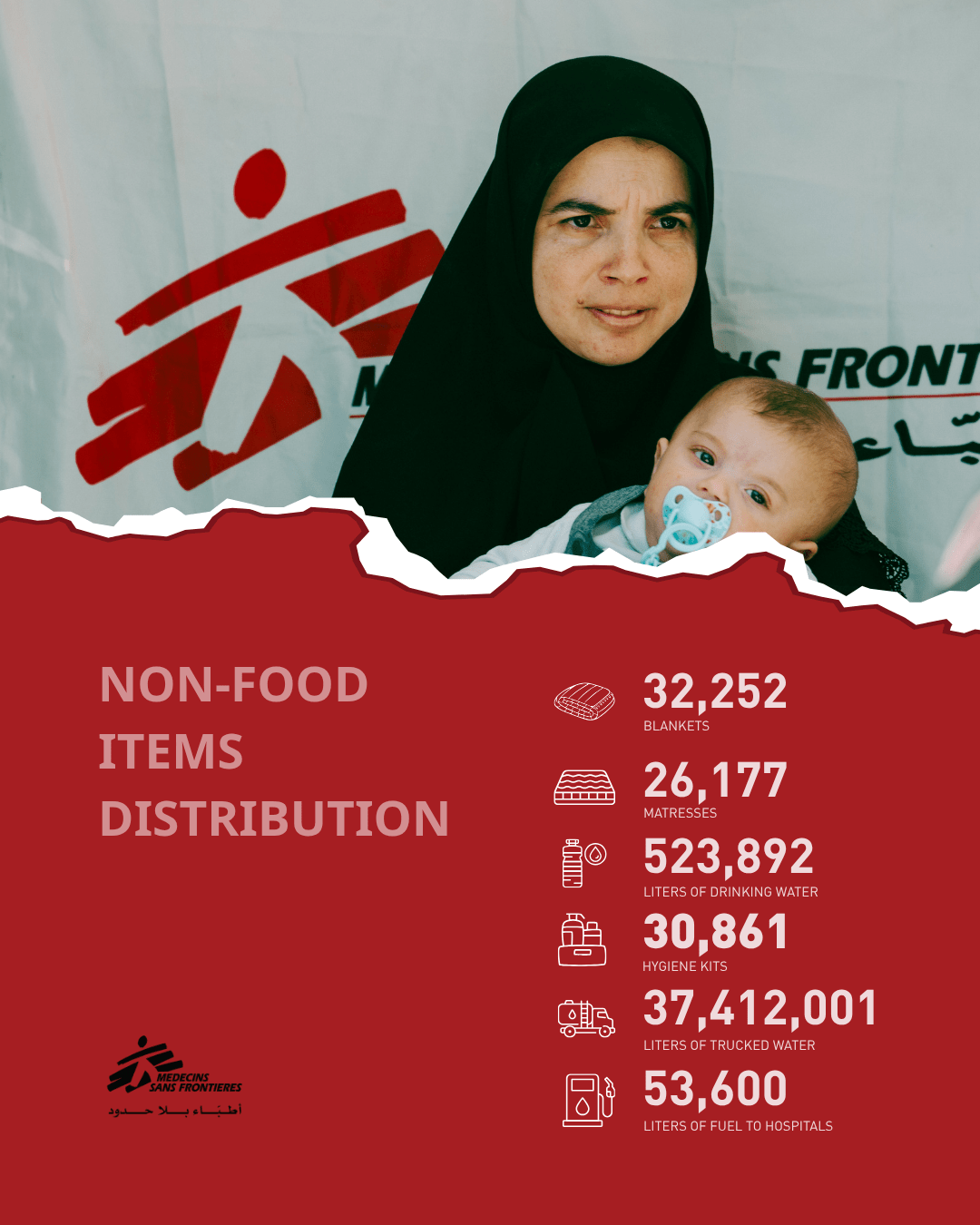
The scale of displacement is stretching the already limited capacity to provide shelter and basic assistance, including healthcare, water, and sanitation services. Many displaced people are lacking essential relief items such as mattresses, blankets, hygiene kits, and cleaning supplies. Clean water and sanitation support are also critically needed, particularly in overcrowded shelters and for people who remain stranded. 

Overcrowded collective shelters, poor living conditions, and lack of privacy are also increasing protection risks, especially for women and girls. Following Israel’s announcement of a ground incursion, older people and people with disabilities were trapped in border towns as reports of a ground incursion made evacuation increasingly difficult. 

Mass evacuation orders, including those issued for Beirut’s southern suburbs and for more than 150 towns and villages south of the Litani River, raise serious concerns. Amid ongoing violence and uncertainty, any sense of normal life has been shattered. Families already struggling to cope are facing immense psychological strain, living in constant fear, repeated displacement, and deep insecurity. 

Nearly two years of conflict have already left Lebanon’s services and resources under severe pressure. The latest escalation is deepening that strain at a time when funding cuts to global humanitarian aid have reduced emergency contingency stocks. With displacement rising rapidly, urgent support for shelter, water, and healthcare is needed. 

Medical impact & access to healthcare 

Access to healthcare in Lebanon is becoming increasingly difficult as attacks, displacement, and evacuation orders disrupt both services and patients’ ability to reach them. The latest escalation is hitting a health system that was already extremely fragile after months of continued violence and unmet needs following the 2024 war. 

Primary healthcare centres and dispensaries in many areas are overwhelmed by the number of patients and are struggling to maintain continuity of care. In some locations, health facilities themselves fall under evacuation orders, directly disrupting services and leaving patients with fewer options to access treatment. 

Displacement is creating additional barriers to care. People forced to flee are struggling to access primary healthcare, essential medicines, and follow-up treatment, particularly for chronic diseases and acute conditions.  

Hospitals in affected areas are also under pressure as they receive casualties from ongoing attacks. At the same time, as in the 2024 escalation, attacks and impacts on healthcare facilities and healthcare workers have again been reported, further weakening the health system’s capacity to respond. According to OCHA, as of 9 March, five hospitals and 48 primary healthcare centres had been evacuated or forced to close. The Ministry of Public Health reported 14 health workers killed and 24 injured, including two paramedics wounded in an attack on a Lebanese Red Cross ambulance in Tyre district. 

Mental health needs are also increasing sharply. People who have already endured repeated displacement and prolonged insecurity are once again living under bombardment, uncertainty, and fear, while access to appropriate support remains limited. 

MSF Emergency Response

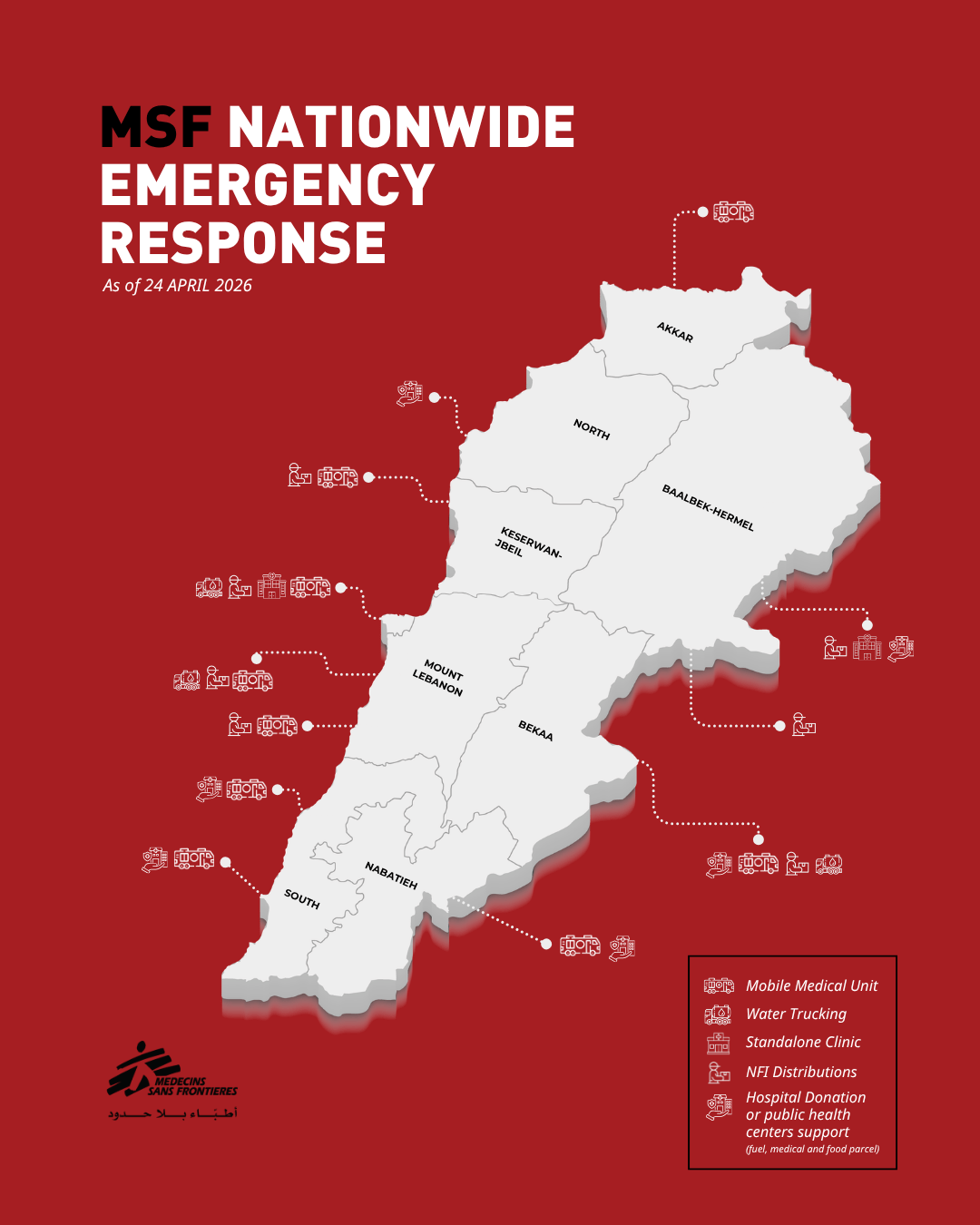
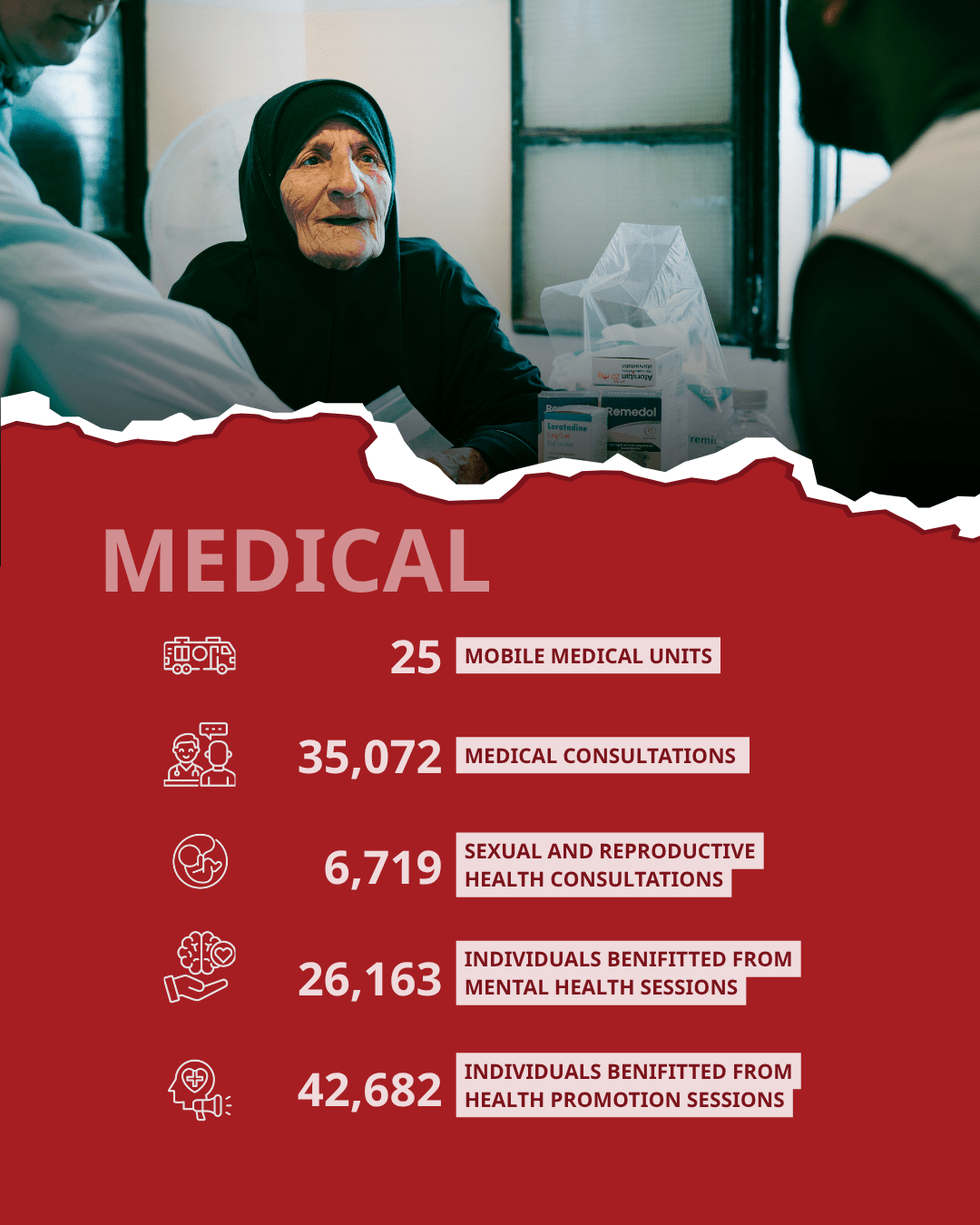
Our teams across Lebanon are quickly adapting their activities to respond to the emerging needs. MSF deployed newly established mobile clinics across the country, including Beirut, Saida, Barja and Aley in Mount Lebanon, Rashaya, Jeb Jenine, and Bar Elias in Bekaa, Arsal and Baalbak in Baalbek-Hermel, and Bebnine in Akkar, to provide medical consultations and psychological first aid to displaced people. Our teams are also mobilising to launch additional mobile clinics, as well as mental health helplines to support people on the road or those unable to reach services. 

MSF has also started water trucking, non-food item distributions, and shelter support in several areas across Lebanon, including Beirut, Saida, Chouf, Akkar, and Mount Lebanon, to help meet the immediate needs of displaced people. 

At the same time, MSF continues to run its existing clinics in Bourj Hammoud in Beirut and Arsal and Hermel in Baalbek-Hermel governorate to ensure continuity of care for patients. MSF also continues to support the primary healthcare centres it was already supporting in Tripoli. 

We remain in close contact with the Lebanese authorities and other actors and stands ready to increase its support as needs grow. 

Our Calls

Protection of Civilians and Infrastructure

MSF calls for the protection of civilians, healthcare workers, and medical facilities, and for respect for international humanitarian law in Lebanon.

Scale-up of Funding and Response

MSF calls for a swift mobilisation of emergency and flexible funding to scale up the response to the urgent needs of displaced people and host communities.

Stories From the Field

Across Lebanon, MSF has been strengthening water and sanitation conditions in shelters to ensure people regain access to the essentials including the ability to wash, clean living spaces, manage waste, and protect their health, privacy and dignity after being forced to leave their homes abruptly under Israeli bombardment and blanket evacuation orders.
On Wednesday, 8 April, Israeli forces launched mass-scale strikes across the country, reportedly over a 100 in 10 minutes. Many hit densely populated residential areas, and once again without prior notice or warning. The following is a firsthand account from Safa Bleik, MSF Medical Coordinator assistant and registered nurse, who was part of an MSF team present in the public hospital in Beirut that received some of the heaviest influx of patients.
In the Chouf district near southern Lebanon, thousands of families have sought refuge. Many of the families we meet there—especially mothers and children, like Khadija and her children—have been displaced time and time again, carrying exhaustion and fear on top of immediate medical needs.
Read the story of Khadija*, 56, from Odaisseh (a border village in the Marjeyoun District, Nabatieh Governorate, south of Lebanon) displaced to Marwaniyeh (Saida District.)
Sana, an MSF colleague from Sarafand, southern Lebanon, describes the moment they received the news that Israel is forcing them to evacuate her town and what it feels like to be living in a seemingly unending cycle of threats and displacement.
Since the early hours of this morning (2 March 2026), tens of thousands of people have been fleeing their towns and homes, following relentless Israeli bombings on several areas of Lebanon.
“Love of my life, who could have imagined what the world had in store for us?”
At 85 years old, Sekna remembers the moment she had to flee her home in Aita Al Jabal, a village in southern Lebanon.
“We are the people of Baalbek, we honour our guests, with whatever means available.”
Testimony collected on 1 November from a school sheltering displaced people in Bichwet, Baalbek-Hermel governorate, Lebanon.
“Whatever we lose, we will come back”
MSF’s mobile medical teams have been visiting several locations in the southern city, offering general healthcare, medication, and mental health support to people displaced by the violence. Here are some of the testimonies of our patient
A little safety and a lot of anxiety
The Azarieh shelter, once a bustling commercial center in the heart of Beirut, has been transformed into a refuge, we met families forced to flee the southern suburbs of Beirut as the Israeli bombardment of populated areas intensified, seeking safety.
"I hope we can return to our houses; if there are houses to go back to"
As the large-scale Israeli bombardment continues in Lebanon, nearly 1 million people have been forced from their homes in a desperate search for safety.
"My house is no longer habitable"
Due to the ongoing conflict on the Lebanese Southern border, Husn Al Sayyed's house suffered damage and now resides in an abandoned hotel repurposed for a collective shelter.
MSF mobile clinic team in South Lebanon
Learn more about MSF response in South of Lebanon and the MSF's mobile clinic teams who work to provide medical services to the displaced population.
Taking shelter in an abandoned hotel in South Lebanon
Relentless armed conflict along Lebanon’s southern border have left thousands displaced, just outside Saida, an abandoned hotel-turned-collective-shelter houses over 220 individuals is the latest site for the delivery of our healthcare services.

News

MSF: Indiscriminate strikes on highly densely populated areas are completely unacceptable
April 8, 2026
Lebanon: Families face uncertainty under bombardment and new evacuation orders
March 13, 2026
Latest escalation worsens migrant communities access to healthcare
April 2, 2026
Israeli attacks cut off access to care
March 25, 2026
MSF scales up response as displacement rises across the country
March 7, 2026
Humanitarian needs in Lebanon: the post ceasefire landscape
January 14, 2025
Lebanon: Surviving war with community-led care
November 6, 2024
Beyond Survival: Helping Children and Adults Cope with the Traumas of War in Lebanon
October 22, 2024
MSF urges for protection of civilians and medical staff amid Israeli bombardment in Lebanon
October 10, 2024
Israel’s bombardment causes unprecedented mass displacement
October 4, 2024
MSF is stepping up its response to the Israeli bombing in Lebanon
September 27, 2024
Thousands displaced and urgent healthcare needs
July 25, 2024
Five months into conflict, displaced people’s needs are rising
March 21, 2024
MSF provides healthcare to people displaced by military escalation along southern border
January 8, 2024
Facebook
X
LinkedIn
WhatsApp
Print