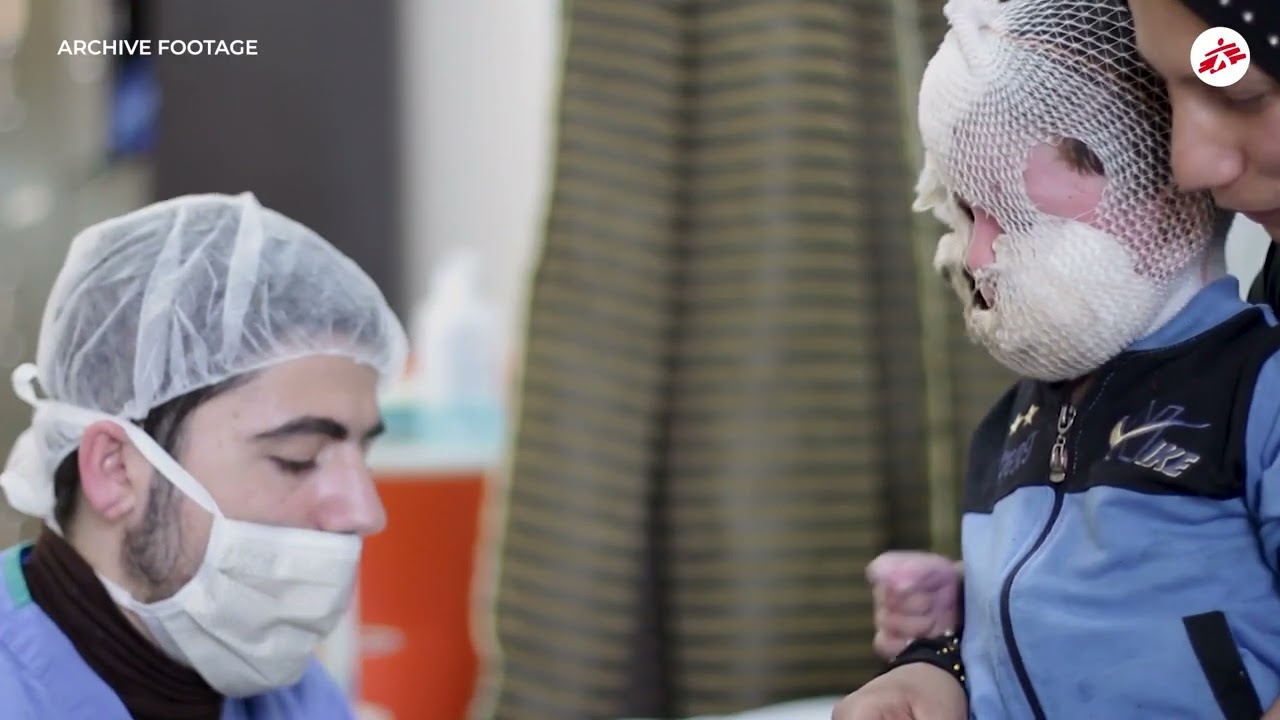
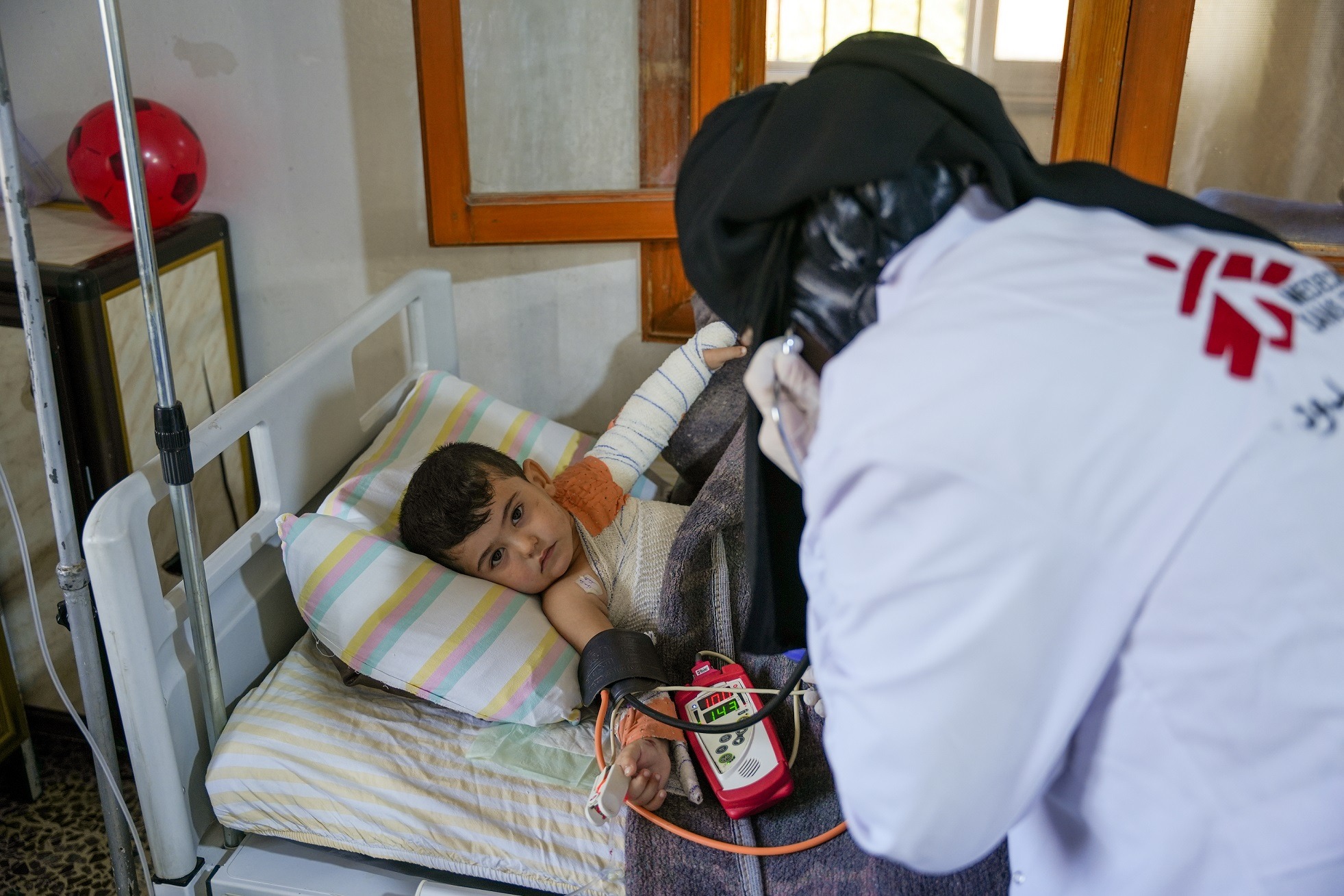
Before March 2023, Idlib surgical hospital had a small ward dedicated to burn patients. But it had to close at the end of march, as the international financial support it was receiving stopped. Since then, all the burn patients of northwestern Syria now seek care from MSF.
After the earthquake, MSF teams mobilized to transform the medical facility and adapted their care to be able to increase capacity. They managed to open 12 new beds, increasing the capacity from 17 to 29 beds. Additionally, they opened advanced points for people to be discharged from the hospital and receive follow-up care, like mental health care, dressing and physiotherapy, closer to their homes. This increased the number of emergency care and surgery patients they could care for. It also decreased the number of patients that would stop their treatment as they couldn’t afford to travel to receive follow up care.
Receiving such severely burnt patients has raised another challenge, because at some point these patients need to be admitted in an Intensive Care Unit (ICU).
A critical lack of beds in intensive care units (ICU) in northwest Syria
Burn patients are at high risk of infects. They are suspectable to high fever, severe respiratory and problems—signs of sepsis. If this happens, they require very close attention and special care. When someone has burns to more than 40 percent their body, the respiratory system suffers. This often requires intubation, which can only be done in an ICU with proper equipment and where patients are closely monitored. MSF Burn Unit doesn’t have an ICU. Mohamed Darwish, director of the hospital, explains the efforts made by the team to adapt and find solutions for these patients, when referrals to other facilities in Turkiye stopped after the earthquake.
“First, we have contacted many hospitals, asking them to receive these patients in need of ICU, but right after the earthquake, all of them refused, except a pediatric hospital. Hospitals feared burn patients would transmit infections to other patients. But this pediatric hospital agreed to collaborate with us and to receive children patients in their ICU. However, they had only two beds for intensive care. Later, Idlib hospital also accepted some of our patients.”
When a patient is admitted to an ICU at another facility, MSF’s medical team continues to care for their burns. Five-year-old Majid has burns to 45 percent of his body. After operating on him, MSF referred him to Idlib hospital, with close follow-up by our own operation theatre team. At the same time, they were trying to get him accepted for follow up care in Turkiye. After a month, when the cross-border referral system slowly re-opened for one or two life-saving cases per week, he finally was accepted.
“As far as we know, he is still in Turkiye and in a difficult situation, with respiratory problems. Sometimes it is heartbreaking,” says Hiba Birawe, who supervises the mental health support provided to the patients and their caretakers, and had been in touch with Majid’s family daily.
When “Miracle” patients give strength to go on
One patient is remembered as a “miracle” by the whole MSF team. Considered a ray of light during this challenging period. Her name is Tuqa. She is a 10 years old and suffered from burns to 45 percent of her body. Far more severe than what the team usually sees. She was injured by boiling water at home. Abdel Malik shares her story:
“She spent a full month in our hospital. After that, we referred her to the pediatric hospital where she was admitted to the ICU. She stayed there for 15 days, intubated. We provided the pediatric hospital with the specific medication she needed. We also sent a surgeon, an anesthetist doctor, nurses for dressing change, and our medical materials to support the medical team of this hospital. When discharged from ICU, the patient came back to the Burn Unit to be operated on. We did small skin grafts for all her body, to avoid scarring and infection, step by step, cautiously. We cannot do only dressings, or her skin would become more prominent and form scars.
“Now, Tuqa is discharged from both hospitals and she is feeling well. This was an amazing success! Overall, she stayed more than two months in hospitals. Now, she is healed, she is walking and talking. She comes to our medical facility only for follow-up care. This happened in April, when the referral system with Turkiye was still completely blocked.”
11 years of MSF presence in Atmeh in a land locked area
For eight years, the escalation of the conflict prevented MSF international staff to be physically present inside northwest Syria between 2014 and 2022. MSF’s Syrian team has been running the facility on their own, with only remote support. They have been supporting their local community and were the first to respond to the earthquake emergency, deploying staff, opening the warehouses and ambulances in the very first hours.
“The war has cut us off from the outside world since 2014, almost until the earthquake. Only after this were our colleagues able to visit us, as authorization to enter Northwest Syria became less [restricted]”, says Abdel Malik Araour.
For MSF and for other organizations, the eased access to northwestern Syria after the earthquake and numerous assessments and visits since then paved the way to a renewed awareness of the dramatic situation faced by people there. After 12 years of war and a decade of relying on humanitarian support, the closure of the referral system to Türkiye meant thousands of patients in the region would have no access to lifesaving care. NWS health system is still highly dependent on aid and vulnerable.
Regarding Atmeh, it has also been the opportunity to acknowledge the remarkable experience and commitment of MSF Syrian team throughout these incredibly difficult years.
MSF calls for more support to help the development of specialized care inside northwest Syria
Providing quality care for burn patients requires extensive experience, long stays in the hospital, and high costs. Therefore, it has proven particularly difficult for other hospitals to maintain this activity at a time of uncertain and decreasing funding.
MSF is calling for more heath organizations to support the development of specialized, sustainable care in northwestern Syria to ensure access to lifesaving care for this community that is facing the consequences of more than 12 years of war.
What are the new horizons for the victims of burns in northwest Syria?
MSF continues to support the victims of burns in northwestern Syria. MSF is currently constructing a larger upgraded facility near the current burns care unit. In about a year, it will be ready to welcome patients and replace the current facility, renewing our commitment to quality and multidisciplinary care and the ability to provide follow-up treatment to patients.
“Inside the new burs unit, there will be an operating theatre fully dedicated to reconstructive surgery,” says Dr. Moheeb, enthusiastically. “We will be able to provide surgeries that are impossible to get in the whole region of northwestern Syria at the moment”.






 Play
Play